
- Users
- Church leaders and communications teams
- Input
- Church profile, scripture or sermon material
- Output
- Content drafts and branded graphics
- Our role
- Product design and engineering
The work around the writing
A church may need a bulletin introduction, several social posts, small-group questions and a prayer guide around the same week's material. The writing changes by format, but its context should remain consistent. Denomination, translation and tone are part of the brief, not details to re-enter for each output.
Heylo is an Uppercut Labs product built around that recurring job. It gives the team a reusable church profile and a workspace for producing the related formats. The product is a public example of our AI software work, rather than a commissioned client deployment.
Make the organisation's context reusable
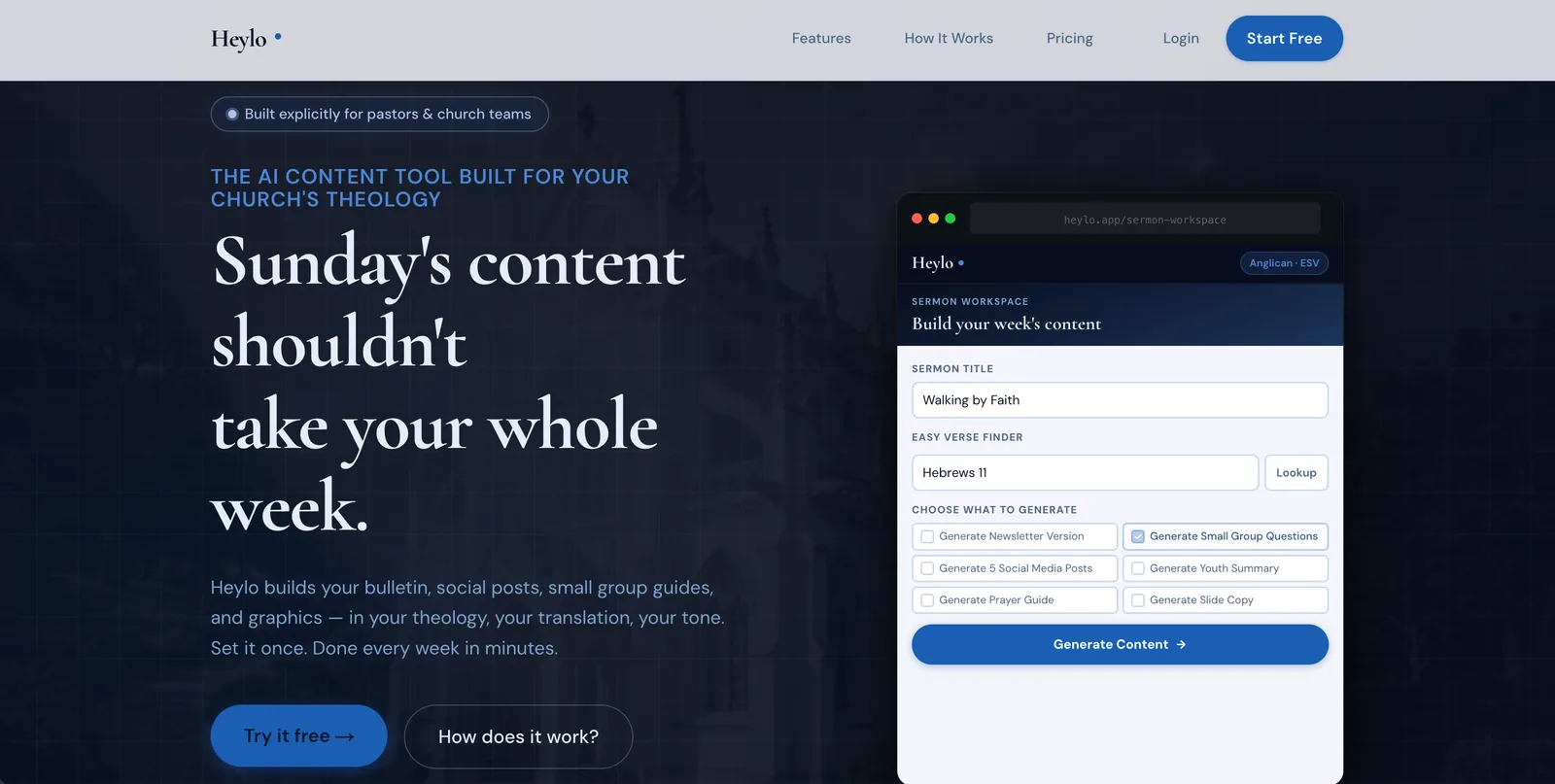
The profile records the church's denomination, preferred Bible translation, doctrinal distinctives and communication tone. A session then adds the immediate subject, such as a scripture reference or sermon material. Those two kinds of context serve different purposes: the profile carries continuity, while the session supplies the current task.
This pattern is relevant beyond faith organisations. A business has recurring constraints too: terminology, service definitions, customer expectations and things it should not claim. Giving those facts a deliberate place in the product is more manageable than relying on each person to remember a long instruction every time.
Design around a finished piece of work
The workflow groups outputs around the same source material: bulletin and newsletter copy, social posts, discussion questions, prayer material and graphics. The team can review and take away the format it needs. A useful AI interface reduces the coordination around generation as well as the effort of writing a draft.
- Persistent organisation context instead of a blank start for every task.
- A shared source for several content formats within a preparation session.
- An interface built around the publishing work a small team already does.
- Reviewable output that the organisation can adjust before using.
What this project demonstrates
Heylo demonstrates an end-to-end AI product with a defined audience, reusable context and a practical output workflow. It connects product design to the model's role rather than treating generation as an isolated text box. The live product lets a prospective client inspect the experience for themselves.
It does not establish a universal time saving or a guarantee of correct theological output. People remain responsible for checking material before publication. We have not published a controlled outcome study here, so this page makes no numerical ROI or accuracy claim.
Applying the pattern to a business
The same scoping questions apply to a proposal assistant, an internal knowledge tool or another specialist content product. Which facts persist? What changes with each request? Where does the source come from? Which outputs need review? How will the team recognise a good result?
If the process needs its own interface and data model, explore AI integration and software development. If it belongs inside an existing team tool, a custom agent may fit better. The starting point is the workflow and its users.